Greg Lees

I design operations
for growing teams

Giving your team the clarity,
consistency, and AI-native systems to scale

$3.3M+ in recurring revenue supported by operations built from scratch
3x Ops-supported
headcount growth
at a high-growth
tech startup
190 Hours saved using AI to generate relevant content and route for review
"Greg is excellent at making progress and solving problems, even with uncertainty and unclear direction." Stacie H.  |  Director, Digital Transformation Center  |  UDRI

Work That Shipped

AI Agents for Operations

Built with AI

Two agents running in production, handling recurring content and research work every week without manual oversight for the routine parts.
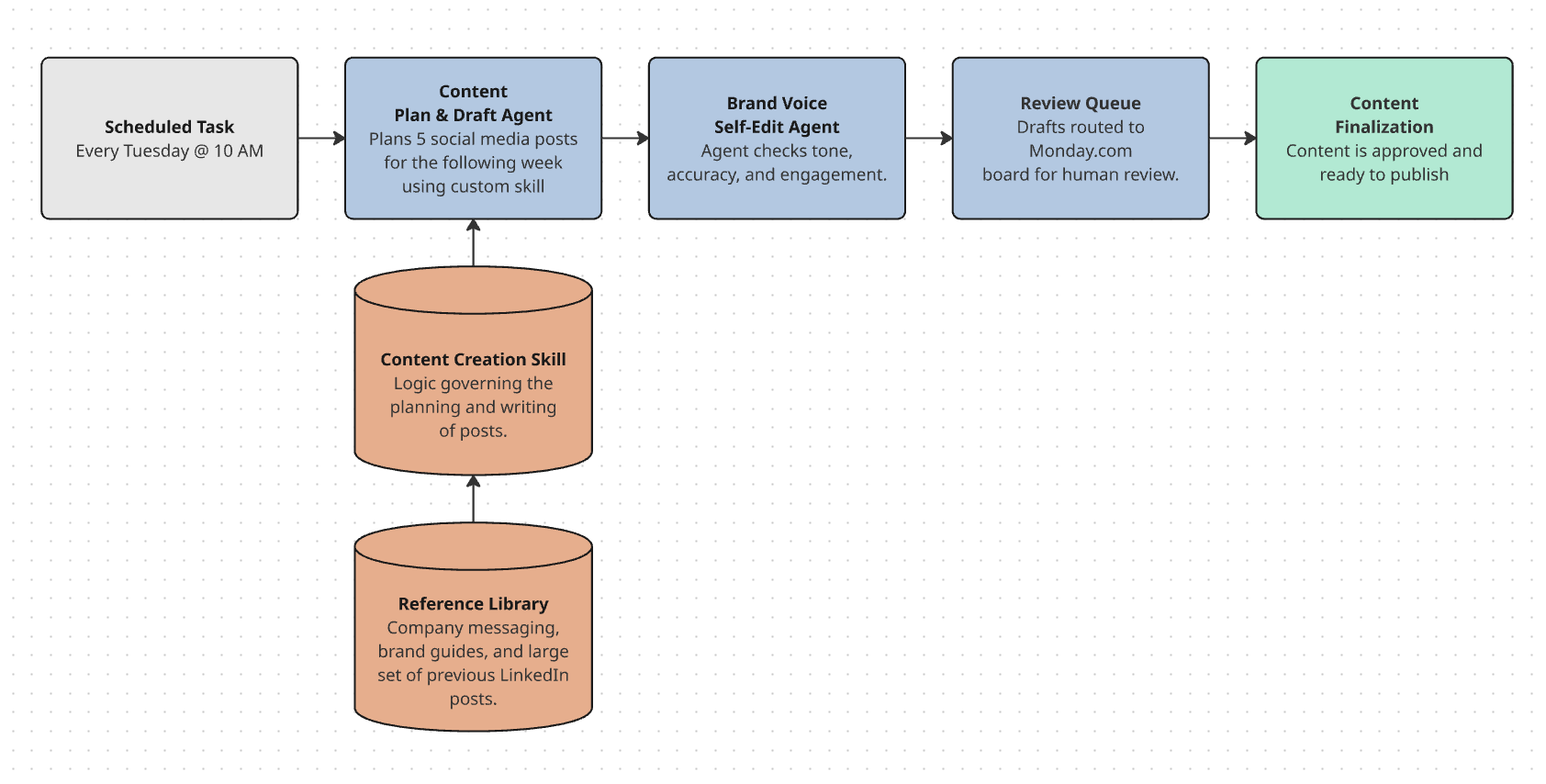
LJB's content and research work was going to keep eating hours as the team scaled, so instead of hiring around the bottleneck, I removed it. I built and run two production agents that operate on schedules and handle real business workflows: one plans, drafts, brand-edits, and publishes 5 social posts every Tuesday, pulling from a structured library of company messaging and practice guidelines, then routes each post into a colleague's review queue automatically. The other researches upcoming industry conferences for missing details like dates, deadlines, costs, and booth requirements, flags anything it can't verify instead of guessing, and only writes to our project tracker after I confirm the findings.
LJB's content and research work was going to keep eating hours as the team scaled, so instead of hiring around the bottleneck, I removed it. I built and run two production agents that operate on schedules and handle real business workflows: one plans, drafts, brand-edits, and publishes 5 social posts every Tuesday, pulling from a structured library of company messaging and practice guidelines, then routes each post into a colleague's review queue automatically. The other researches upcoming industry conferences for missing details like dates, deadlines, costs, and booth requirements, flags anything it can't verify instead of guessing, and only writes to our project tracker after I confirm the findings.
Content agents workflow screenshot

Content Operations at Scale

Built with AI

963 social posts and a full editorial calendar generated and queued in Monday.com, saving an estimated 190 hours of manual research, drafting, and tracking.

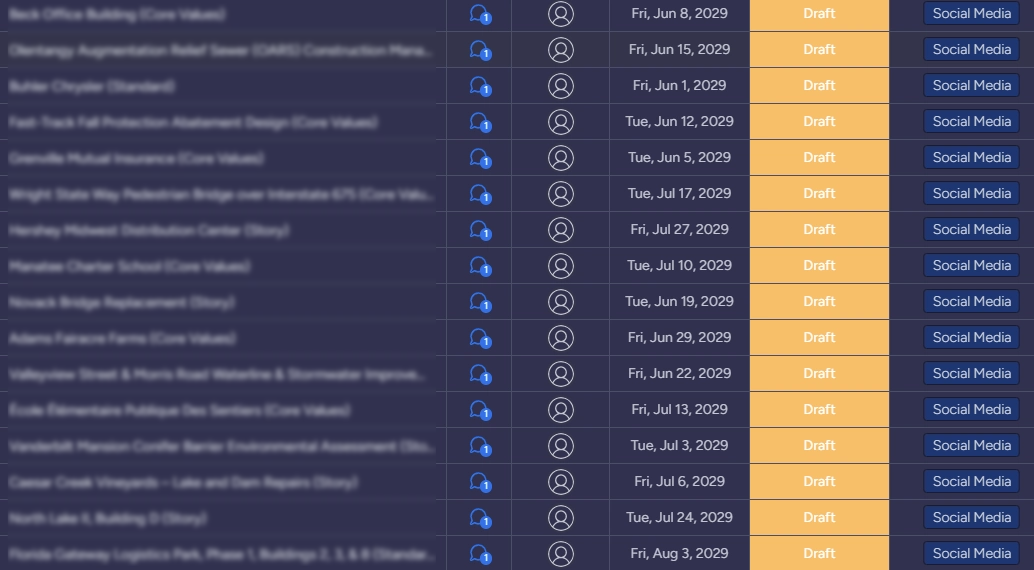
A backlog of unpublicized project wins meant marketing was leaving credibility on the table, so I built a pipeline to turn that backlog into a year of content instead of writing it one post at a time. I extracted all projects from our website and put them in an excel table with all key information. Then I had the AI create three versions of each post (standard, core values, and storytelling). Lastly, I sent them straight to our Monday.com board with the draft and a post date based on the timeline I gave it.

A backlog of unpublicized project wins meant marketing was leaving credibility on the table, so I built a pipeline to turn that backlog into a year of content instead of writing it one post at a time. I extracted all projects from our website and put them in an excel table with all key information. Then I had the AI create three versions of each post (standard, core values, and storytelling). Lastly, I sent them straight to our Monday.com board with the draft and a post date based on the timeline I gave it.

Claude Cowork workflow screenshot

AI-Assisted HubSpot Landing Page

Built with AI

A fully custom landing page hosted in HubSpot, without a developer, without a third-party page builder, and without compromising on design.

HubSpot's page builder was going to cap how the brand could look, so instead of accepting that ceiling or paying for a developer, I decided to build around the tool instead of inside it. Fixed layouts, limited flexibility, and a finished product that rarely matches what marketing actually envisioned — building the page with AI instead removed that ceiling and gave the team something cleaner, more polished, and fully on-brand.

HubSpot's page builder was going to cap how the brand could look, so instead of accepting that ceiling or paying for a developer, I decided to build around the tool instead of inside it. Fixed layouts, limited flexibility, and a finished product that rarely matches what marketing actually envisioned — building the page with AI instead removed that ceiling and gave the team something cleaner, more polished, and fully on-brand.

AI-Assisted HubSpot Landing Page

GTM Operations Infrastructure

A fully systematized GTM function built from zero, giving a 14-person team the operational foundation to execute without the administrative overhead.

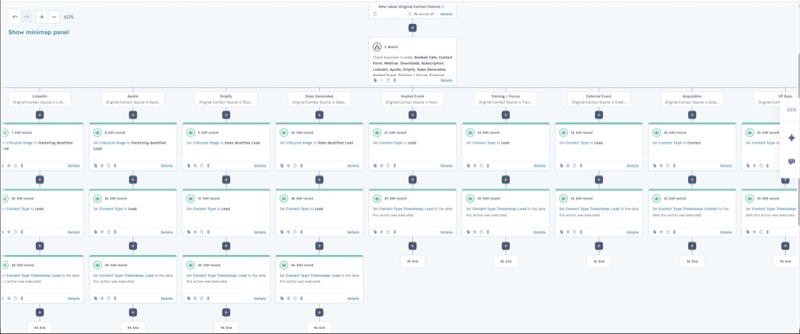
A 14-person GTM team was about to scale past the point where tribal knowledge works, so I got ahead of it before the breakdowns started. Leads came in and disappeared. There was no shared definition of a qualified lead, no routing, no reporting, and no way to know what happened after a handoff. I built the whole system that included lifecycle stages, MQL criteria, contact management, segmentation, automated workflows, and real-time reporting in HubSpot.

A 14-person GTM team was about to scale past the point where tribal knowledge works, so I got ahead of it before the breakdowns started. Leads came in and disappeared. There was no shared definition of a qualified lead, no routing, no reporting, and no way to know what happened after a handoff. I built the whole system that included lifecycle stages, MQL criteria, contact management, segmentation, automated workflows, and real-time reporting in HubSpot.

GTM Operations Infrastructure

Partnership Operations from 0-to-1

A partnerships operation built from nothing that became the operational backbone for one of Minor League Baseball's best-attended franchises.

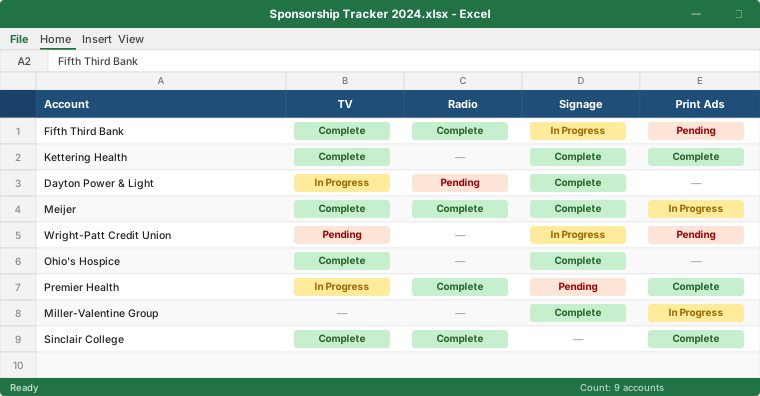
$3.3M in partnership revenue was one departure away from chaos, so I treated that as the real risk and built the infrastructure before it became one. The Dayton Dragons were managing it the way a lot of teams manage things when they're moving fast, across inboxes, individual memory, and spreadsheets nobody else could follow. With 60+ accounts and cross-functional execution involved, there was no single place where any of it lived. Activation workflows didn't exist and delivery was held together by different individuals. I built the infrastructure from scratch to develop centralized systems, delivery workflows, partner communications, and the engine to run it all.

$3.3M in partnership revenue was one departure away from chaos, so I treated that as the real risk and built the infrastructure before it became one. The Dayton Dragons were managing it the way a lot of teams manage things when they're moving fast, across inboxes, individual memory, and spreadsheets nobody else could follow. With 60+ accounts and cross-functional execution involved, there was no single place where any of it lived. Activation workflows didn't exist and delivery was held together by different individuals. I built the infrastructure from scratch to develop centralized systems, delivery workflows, partner communications, and the engine to run it all.

Partnership tracking spreadsheet

AI as a Force Multiplier

AI is more than a surface level tool. It's part of how I design operations from the start, which is why it shows up at every layer, from daily problem-solving to production agents.

Layer 4 | Code

Building Agents

I build and run production agents that operate on schedules and handle real business workflows on their own. I also built this website entirely in Claude Code, from terminal to deployed site. See AI Agents for Operations for the full breakdown.

Layer 3 | Cowork

Automating Workflows

I use Cowork to run multi-step content and research workflows end-to-end, from raw source data to a finished, scheduled deliverable. See Content Operations at Scale for the full breakdown.

Layer 2 | Design

Designing & Building

Designed and built landing pages for LJB in Claude Design, handed them to Claude Code to finish, and deployed them live inside HubSpot. See Work That Shipped for the full breakdown.

Layer 1 | Chat

Everyday Problem-Solving

I use AI chat as a first step for fast troubleshooting and building step-by-step plans on new projects, while making sure I actually understand the process, not just outsourcing it. I also use it to build custom skills and plugins that extend what Claude can do for me.

What People Say

I don't wait for a playbook

When I join a team, I orient fast, find what's broken or missing, and start building, while keeping the people who have to live in these systems at the center of every decision.

Clarity First

Define success before building solutions.

Design for Adoption

Tools only work when people actually use them.

Bias for Momentum

Progress beats perfection.

Stay Lean

Don't spend money or add tools until you've outgrown what you have. Complexity is a cost.

Certifications

HubSpot

HubSpot

Marketing Hub Certification
Sales Hub Certification
Revenue Operations Certification

Notion

Notion

Essentials Certification
Workflows Certification
Advanced Certification

Make

Make

Foundation Certification

Why Your Team Needs a Generalist

Most early-stage teams don't have an operations problem. They have a "no one owns this" problem.

Specialists deepen expertise. Generalists create the connective tissue between it.

For me, that's meant building operations across business, marketing, and revenue functions, and wherever else a growing team needed someone to own the system, not just a piece of it.

Let's talk.

If your team is growing faster than your systems and you're ready to fix that, I'd love to chat!